On May 4, 1886 a group of between two and three thousand workers were lawfully and peacefully conducting a rally in an area of Chicago known as Haymarket Square.As the last speaker was finishing his speech, the police marched in formation towards the crowd and demanded that they disperse.In the confusion, someone threw a pipe bomb at the police which killed several officers.The police fired back at the crowd killing an untold number of civilians.What followed has been called America’s first Red Scare.Ten men were indicted and eight were convicted (one fled the country and one turned State’s evidence).Seven of the eight men convicted were sentenced to death.One committed suicide before sentencing could take place and two of the remaining six received clemency.However, four men were still hung for the events that took place on the evening of May 4, 1886.Over a century later, we are still asking ourselves if these men were killed for their actions or their anarchist beliefs.
Eight Hour Movement:
The events that led to the incident at the Haymarket Square that evening were set in motion decades earlier.On March 2, 1867, Illinois Governor Richard J. Olgesby signed into law the Nation’s first eight hour law.The law was scheduled to go into effect on May 1, and many believed that once it did, workers would no longer think of their jobs as a life sentence.Industrial workers would have leisure time to educate themselves and work their way up from poverty.However, since this law was full of loopholes and did not include any enforcement powers, most employers chose to ignore the new legislation.[i]
On May 2nd, when employers forced their employees to work their full ten to eleven hour days, workers went on strike and forced much of the industry in Chicago to close.On May 3rd and 4th, strikers armed with sticks and fence posts walked up and down the streets forcing workers out of their factories, slashing machine belts, and released the pressure from the boilers.Chicago Mayor J.B. Rice made it illegal to intimidate any worker who wanted to work the full day.In addition he called upon the Dearborn Light Artillery to help the police restore order.By May 8 the strike was over.Despite the failure of the eight hour day, the date May 1st would hold a special significance to members of the labor movement.[ii]
[i] James Green, Death in the Haymarket:A Story of Chicago, The First Labor Movement and the Bombing That Divided Gilded Age America(New York:Pantheon Books, 2006), 25, 30
New York Times account of The McCormick Reaper Works Riot
[May 4, 1886]
The Federation of Organized Trades and Unions was founded in Pittsburgh in 1881.Since then, their membership had been declining.They decided that one way to boost membership was to support the eight hour movement on a national stage.In 1884 at its convention in Chicago, the Federation of Organized Trades and Labor Union passed a resolution that declared the eight hour day would go in to effect on May 1, 1886.The leadership of the union never expected their members to actually strike on May 1, 1886, but the rank and file saw this date as their emancipation day.When Chicagoans woke up that morning, most of the smoke stacks were silent and the smoke cloud that normally hovered over the city was gone.Nationwide over 300,000 workers walked off their jobs, 40,000 in the city of Chicago alone.Albert Parsons led 80,000 workers in a parade down Michigan Avenue with his wife Lucy and his two children by his side.[i]
Everything remained peaceful until May 3rd.August Spies, editor of the German anarchist newspaper the Arbeiter-Zeitung, had gone to speak to members of the Lumber Shovers’ Union, just a few blocks from the McCormick Reaper Works (present day International Harvester).His speech had nothing to do with the McCormick Reaper Works, who was in the middle of their own labor dispute.In 1885, Cyrus H. McCormick had cut wages fifteen percent across the board, but was forced to reinstate those wages following a strike.A few months later, he introduced new machinery that eliminated the jobs of the workers who had organized the walkout.Finally in February 1886, he locked his remaining employees out of the building and replaced them with non-union workers.[ii]
August Spies arrived at the rally at about three in the afternoon.He described the previous speaker as poor and the crowd as disinterested.He climbed on a boxcar and addressed the crowd.Because many of the workers that had been locked out of the McCormick plant were standing around, it was a much larger crowd than usual.Spies had spoke for twenty minutes when a bell rang signaling the end of the workday at the McCormick plant.The timing could not be worse.Although Spies did not mention the McCormick strike, the workers were fired up by his speech and they walked away from the rally with cries of “Kill the scabs” and “Tear the building down.”[iii]The non-union workers were being escorted from the building under police protection when an altercation erupted between the scabs and the strikers.Spies ran over to the McCormick plant and witnessed 200 Chicago police officers hitting strikers with clubs and firing at the crowd.After the police began shooting, the strikers fled.Reports on the number of causalities differ, but there was at least two strikers killed and five wounded. [iv]
[i] Henry David, The History of the Haymarket Affair, 2nd Ed. (New York:Russell & Russell, 1958), 162; Green, 3, 164; Paul Avrich, The Haymarket Tragedy (Princeton:Princeton University Press, 1984), 186.
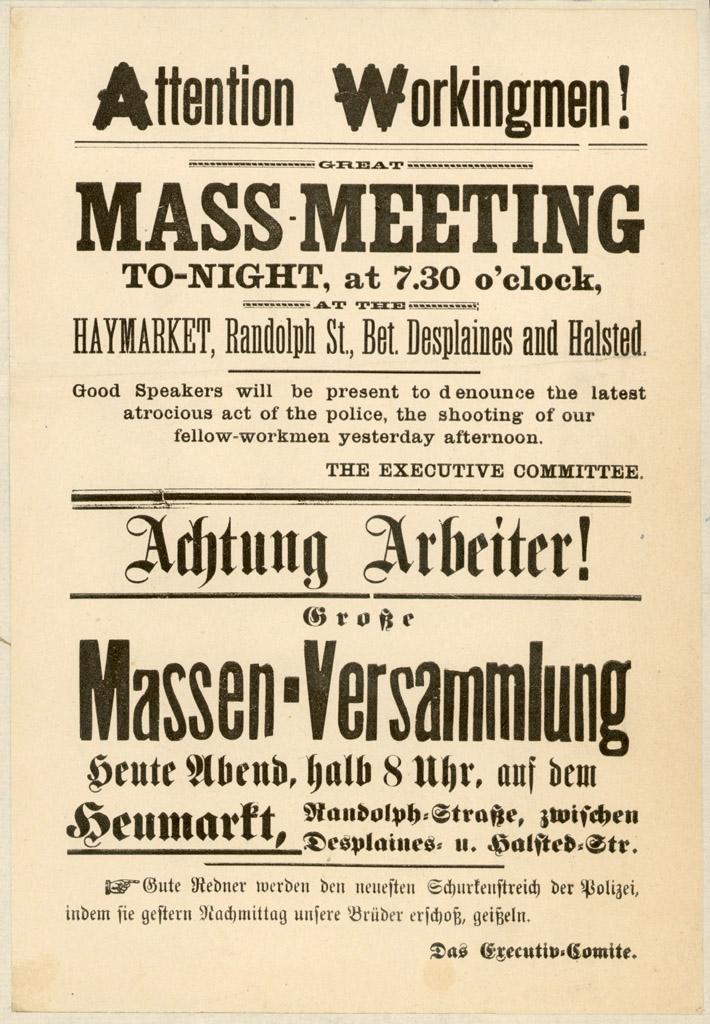
Outraged by what he had witnessed at the McCormick plant, August Spies planned a rally in Haymarket Square the following evening.The Haymarket Square was a commercial business center that is large enough to encompass twenty thousand people.It is formed where Randolph Street widens between Desplaines Street and Halstead Street.August Spies returned to the Arbeiter-Zeitung.He drafted a flyer promoting a rally that began with the line; “Workmen to Arms!” the word “Revenge” was added later without Spies knowledge.[i]On a second flyer composed by Spies, Adolph Fischer, type setter for the Arbeiter-Zeitung, added the phrase, “Workingmen Arm Yourselves and Appear in Full Force!”Spies was angry when he read the text and thought the language would scare people away.He even refused to speak at the rally unless the line was changed, however a handful of these flyers with the original text were distributed.The prosecution would use this as evidence that the anarchists showed up the Haymarket Square looking for trouble.[ii]
Approximately two to three thousand people showed up for the Haymarket Square rally.Chicago Mayor Carter Harrison was made aware of the meeting by one of the flyers.“He instructed Frederick K. Ebersold, the general superintendent of police, that ‘if anything should be aired at that meeting that was likely to call out a recurrence of such proceedings as at McCormick factory the meeting should be immediately dispersed.’”[iii]For this reason, 176 officers were stationed a half block away at the Desplaines Street Station under Captain Bonfield.[iv]
August Spies arrived at 8:15 PM and was very disappointed at the low turnout.Albert Parson was scheduled to speak first, but he was unaware he speaking at the rally because he was out of town at a speaking engagement in Cincinnati and had not return until early that morning.Since Parsons was running late, Spies spoke first and Parsons would follow him.Parsons spoke for almost an hour and there was nothing inflammatory about his speech.At about 10 PM, Mayor Harrison considered the meeting harmless and ordered Captain Bonfield to release the troops he had in reserve, or at least the ones being held at other stations.Bonfield claimed he had already dismissed those troops, but asked that the troops being held at the Desplaines Street Station remain until the meeting was adjourned.Mayor Harrison agreed and left for home.[v]
Samuel Fielden was the last speaker and he started his speech shortly after 10 PM.Ten minutes into the speech, the sky darkened and the wind picked up.With the threat of rain, many people started to leave.There were less than 500 people left as Fielden started to wind up his speech.He concluded with angry remarks about the workingmen killed in cold blood by the police.‘You have nothing to do with the law except lay your hands on it and throttle it until it makes its last kick. . . . Keep your eye upon it, throttle it, kill it, stab it, do everything you can to wound it–to impede its progress.’[vi]Upon hearing this, two detectives left the crowd to report to Captain Bonfield that the speaker was using inflammatory language.Bonfield organized his troops into formation and started advancing towards the crowd.Captain Ward ordered the crowd to disperse.Fielden was still standing on the hay wagon were he had given his speech.“‘But we are peaceable,’ he protested.”[vii] There was a long awkward silence as the police stood their ground.‘All Right, we will go,’[viii] Fielden said as he stepped down from the wagon.Just then someone hurled a pipe bomb towards the police.After the explosion, the police opened fire into the crowd and killed an unknown number of civilians as the crowd ran off in all directions.[ix]
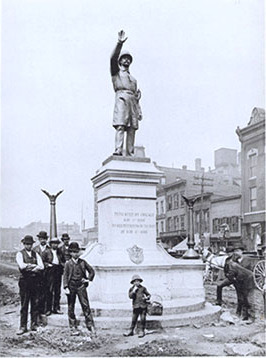
The riot was over in less than five minutes.A fragment of the bomb ripped through Officer Mathias J. Degan’s leg and he bleed to death in a few minutes.Six other officers would die in the next few days because of their wounds.Timothy Sullivan would die two years later because of the injuries sustained at the Haymarket.In addition, sixty other officers had been wounded, many from friendly fire.What followed has been called America’s First Red Scare.Economist Richard Ely referred to the next two months as “a ‘period of police terrorism’—a time when all civil liberties were suppressed in the name of public safety.”[x]Anyone with socialists or anarchist ties were arrested and had their property searched without a warrant.[xi]
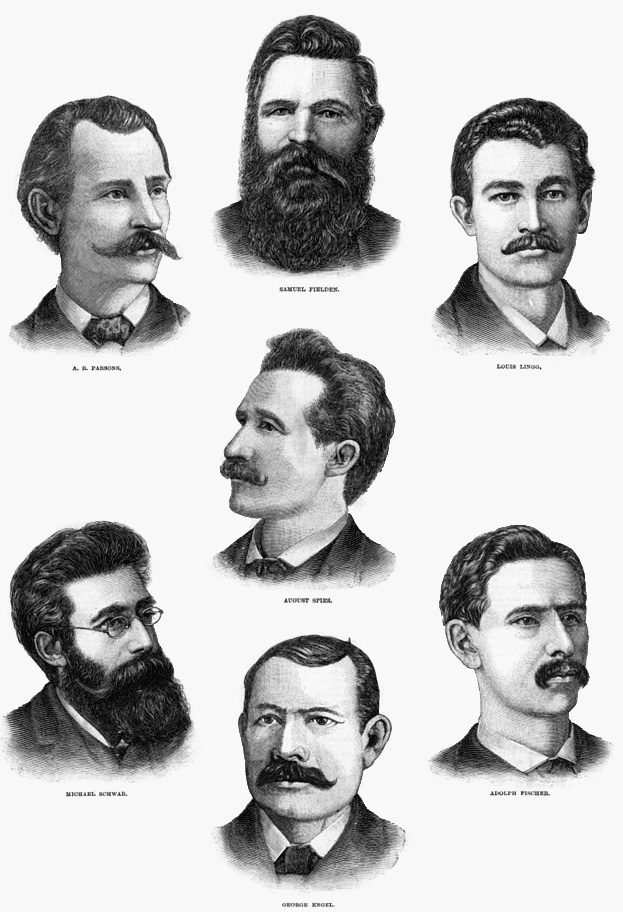
A total of thirty one people were indicted for sixty nine individual counts which included murder, conspiracy and rioting.Of those thirty one, a grand jury indicted ten.August Spies, Samuel Fielden, and Albert Parsons were all in attendance and gave speeches that night.Oscar Neebe, Michael Schwab, George Engel and Adolph Fischer all worked or wrote for the Arbeiter-Zeitung.Also indicted were Louis Lingg, Rudolph Schnaubelt and William Seliger.Many believed that Rudolph Schnaubelt was the bomb thrower, but he fled the country before he could be arrested.William Seliger turned state’s evidence and testified that he spend the day of the bombing assisting Louis Lingg in manufacturing approximately fifty pipe bombs.He helped Lingg load the bombs into a trunk and carried them to Neff’s Hall where several men came and took some of the explosives away.Although, the prosecution’s expert witnesses said Lingg’s bombs were similar to the one used in the attack, they could not conclusively link that bomb to the one’s manufactured by Lingg.[xii]
The trial began on June 21, 1886.Albert Parsons had been hiding in rural Wisconsin for the previous six weeks.He showed up on the first day of court because he believed he was innocent and would not be convicted.Even though the bomber was not on trial, the prosecution argued that the bombing was not an individual act and the actually bomb thrower was not necessary to prove a conspiracy.The next day, the prosecutors produced their star witnesses, M.M. Thompson and H.L. Glimer.Thompson testified that he heard Schwab and Spies talking with Schnaubelt about the police.“He thought the word ‘pistol’ was spoken and that a man he thought was Spies asked his friend, ‘Do you think we have enough?’Thompson took this as a reference to bombs.”[i]Glimer took the stand and claimed that he saw Spies light the fuse of the bomb that Schnaubelt had thrown.[ii]
Neither of these witnesses proved to be credible.The version of the story Glimer told on the stand is greatly different from the story he told to a reporter the day of the incident.The defense called thirteen witnesses that contradicted Thompson and Glimer’s testimony.Although Schwab was present before the rally started, he left early to attend a rally in Deering five miles away and was not present when the bomb was thrown.Spies was still on the hay wagon where he had given his speech.He was in full sight of everyone and could not have lit a fuse without someone else seeing him.In addition, the other five defendants also had airtight alibis.Fischer and Parsons were down the street in Zepf’s Hall.Engel and Neebe were at home.Meanwhile Lingg was at Neff’s Hall on the North Side of town.In fact Lingg, Neebe, and Engle had not attended the rally at all.[iii]
Chicago Mayor Carter Harrison turned out to be the most credible witness.The Mayor testified that he had seen no weapons and after hearing the speeches, determined that there was no reason to interfere.He also testified that he told Captain Bonfield to send his reserves home.If everything was peaceful when the Mayor left after Parson’s speech, what happened to cause Bonfield to disperse the meeting?“The prosecution contended that the tenor of the meeting was such that a responsible police officer, Captain Bonfield, was certain it would terminate in a violent disturbance.So incendiary were the speeches, claimed the state, that they would have incited the crowd to mass violence had not the police interfered.”[iv]However, witnesses testified that less than twenty five percent of the remaining three hundred people were fired up by the speech, and that twenty five percent were divided between people that were enthusiastic toward the speech and people who were hostile toward the speaker.The rest of the crowd was described as indifferent, uninterested, and even bored.[v]
The prosecution failed to present any credible evidence that linked any of the defendants to the bombing.However the biggest weakness in the prosecutions case, was the fact that the actual bomber was never identified.The judge was able to remove this flaw in his final instructions to the jury.He reminded them that in a conspiracy case, the defendants could still be convicted as accessories, even if the identity of the bomber is unknown.The jury returned guilty convictions on all of them.Oscar Neebe received fifteen years in prison and the remaining seven were sentenced to death.The executions were scheduled for December 3, 1886, but the defense argued for a stay of execution pending an appeal.[vi]
The defense appealed to the State of Illinois Supreme Court on several arguments.First, the judge’s instructions to the jury were incorrect.Secondly, some of the comments made by the judge in open court were considered inappropriate.Third, errors were made when impaneling the jury.Fourth, improper and incorrect remarks made by the State’s Attorney during his closing arguments were grounds for an appeal.Five, the State’s Attorney’s case was based on a conspiracy; however his evidence did not support such a theory.Six, much of the evidence against the defendants was obtained without search warrants, and therefore was inadmissible.Despite all of these arguments, the State Supreme Court upheld the lower court’s decision and the executions were scheduled for November 11, 1887.[i]
The defense petitioned the United States Supreme Court on grounds that the defendants Fourth Amendment (illegal search and seizure), Fifth Amendment (Self incrimination), Sixth Amendment (Impartial Jury), and Fourteenth Amendment (Due Process) rights were violated.The Supreme Court ruled that they did not have jurisdiction to hear the case since no federal laws or issues were involved.This meant the only recourse the defense had was to petition the Governor for clemency.Illinois state law required that all convicts seeking clemency had to write a statement of remorse.If such a letter was not written, the Governor could not grant clemency and the hangings would continued as planned.Fielden, Schwab, and Spies asked the Governor for clemency, but Engel, Fischer, Lingg, and Parsons refused to write such a letter.Spies would later withdraw his letter when he learned what a public backlash it created.[ii]
On November 6, 1887, explosives were found in Louis Lingg’s cell.This sparked wild accusations that the anarchists were going to use them to break out of prison.However, the bombs were only six inches long and less than one inch in diameter, which was too small to be used for anything other than suicide.Lingg claims he had no idea how they got into his cell and many assumed that they were planted by the police to derail the anarchist’s attempts at clemency.Four days latter, on the night before the hangings, Lingg placed another similar bomb in his mouth and lit the fuse.The blast blew much of his face off, but he did survive.This brought up the morbid question of how healthy does a man need to be, for the State to put him to death.Louis Lingg died at 2:50 P.M. on November 10, 1887 after several hours of which he remained conscious and in excruciating pain.[i]
Two hours after Louis Lingg’s suicide, Governor Olgesby commuted the sentences of Fielden and Schwab to life sentences.The Governor received thousands of appeals for clemency from all over the world asking him to commute the sentences.In addition, some 100,000 people had signed a petition.The Governor let the defense attorney know that he would be willing the commute the sentences of the other defendants if they were willing to write the required letter.Parson refused saying that asking for clemency was the act of guilty man and he was innocent.Without the letters, legally there was nothing the Governor could do.On November 11, 1887, Albert Parsons, August Spies, George Engel, and Adolph Fischer were led to the gallows.The trap sprang open and the four bodies fell with a loud bang that cut off the last half of Parsons’s words.The four bodies convulsed and twitched for another seven minutes and forty five seconds before they stopped and were pronounced dead.The Haymarket defendants would become martyrs and have their pictures prominently displayed in union halls around the world for decades to come.The three surviving anarchists were pardoned by Governor Peter Altgeld in 1893. [i]
[i] Avrich, 356-358, 360, 393; Green, 258, 285, 270; David, 427, 430, 456, 463; “To Save the Anarchist:Business Man in Favor of Extending Clemency,” New York Times, November 5, 1887, 2; “Why They Were Hanged,” New York Times, November 12, 1887, 1; Chicago Hearld, Novemebr 14, 1887.